
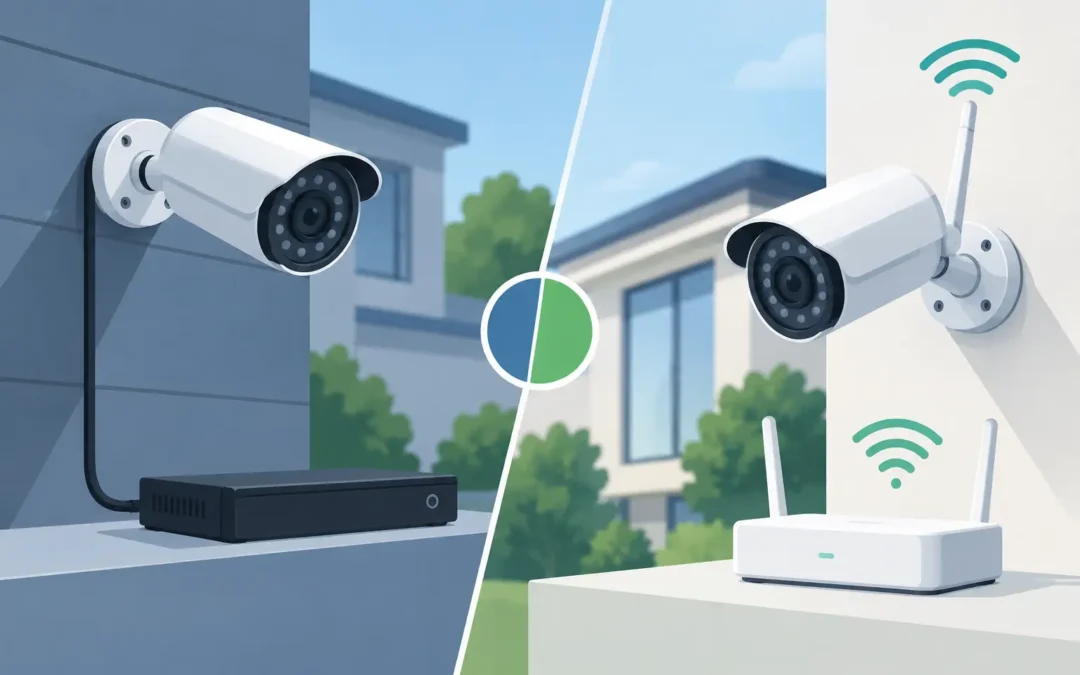
A camera that drops offline when you need footage is not much use, whether it is watching a front door in a London flat or protecting stock at a busy office. The CCTV wired versus wireless decision affects far more than installation time. It changes how dependable your recordings are, how much work is needed to fit the system, and how easily it can grow with your property or business.
For most customers, the right answer comes down to the building, the risks being covered and the quality of the existing network. Wireless cameras can be a sensible choice in the right location, but a properly planned wired system remains the dependable option for many homes and businesses.
CCTV Wired Versus Wireless: The Main Difference
A wired CCTV system sends video and power through physical cables. Most modern installations use Ethernet cable and Power over Ethernet, often called PoE. One cable connects each camera to the network video recorder and provides its power supply. Older systems may use coaxial cable with separate power, but PoE is usually the more flexible choice for a new installation.
Wireless CCTV cameras send video over WiFi. They still need power unless they are battery-operated or solar-powered, so “wireless” does not always mean cable-free. A mains-powered wireless camera may be easier to position than a wired model, but it still needs a nearby socket and a reliable WiFi signal.
That distinction matters. A camera can have excellent image quality on paper but perform poorly if its WiFi connection is weak, crowded or repeatedly interrupted. Equally, running cable through a finished property can take more planning than customers expect.
Why Wired CCTV Is Often Chosen for Businesses
Wired CCTV is generally the stronger option for offices, shops, warehouses, communal buildings and larger homes. Its biggest advantage is consistency. Each camera has a direct cable connection, so its video does not compete with phones, laptops, smart TVs and visitor devices for WiFi capacity.
This is especially useful where several cameras record continuously at high resolution. A business may need clear footage of entrances, tills, loading areas, corridors and storage rooms at the same time. Wired connections handle that load more reliably and make it easier to retain footage on a local recorder.
Reliability during day-to-day use
A cabled camera is not dependent on the strength of WiFi at the far end of a building. Thick walls, metal shelving, neighbouring networks and distance from the router can all reduce wireless performance. In London offices, converted properties and older buildings, those problems are common.
With PoE, there is also less equipment to manage around the site. Cameras do not need individual plug sockets or regular battery charging. A recorder and network equipment can be kept in a secure location, with the option to protect them using an uninterruptible power supply during a short power cut.
Better for permanent coverage
Wired installations suit cameras that need to stay in place for years. They are well suited to external entrances, car parks, reception areas and sites where missing a few minutes of footage could cause a problem. Because the cameras are hardwired, they are also less likely to be affected by local wireless interference or a customer changing the WiFi password.
The trade-off is installation work. Cables need to be routed carefully through walls, ceilings, lofts, trunking or external-grade conduit. A good installation should be tidy, discreet and planned around camera angles rather than simply taking the shortest route for a cable.
When Wireless CCTV Makes Sense
Wireless CCTV has a clear place. It can be practical for renters, small homes, temporary premises or areas where installing a cable would be disruptive or disproportionately expensive. A single camera covering a front door, garden gate or inside hallway may be quick to add if there is strong WiFi and a suitable power source.
Battery-powered cameras are useful where power is difficult to reach, such as a shed, side passage or temporary site. They can also provide an extra viewpoint while a permanent system is being planned. However, they normally rely on motion recording rather than recording all day, as continuous recording would drain the battery quickly.
The limits of WiFi cameras
Wireless cameras need more attention than their advertising can suggest. Their connection depends on router placement, broadband equipment, WiFi coverage and the number of devices using the network. A camera installed at the edge of the property may show a good signal on a phone one day and struggle at busy times or after network changes.
WiFi cameras may also use cloud storage, often with a subscription fee. This can be convenient for checking clips remotely, but it is worth checking what happens if broadband fails, how long footage is kept and whether the camera can record locally as a backup.
For external cameras, choose a model rated for the weather and position it where it can still detect activity without being constantly triggered by passing traffic, trees or pets. Too many false alerts quickly make any security system less useful.
Installation Cost: Look Beyond the Camera Price
Wireless cameras are often cheaper to buy and faster to fit at first. That can make them attractive for a straightforward domestic job. Yet the lowest initial cost is not always the lowest long-term cost. Battery changes, cloud subscriptions, replacement devices and callouts to resolve connection issues can add up.
Wired CCTV usually costs more upfront because of labour, cabling and recording equipment. The investment is often justified when the system covers several areas or needs reliable, continuous recording. A properly designed system can also be expanded later by adding cameras, increasing recorder storage or improving network capacity.
The building itself makes a difference. A compact flat with accessible routes may be straightforward to cable. A period property, a multi-floor office or a listed building may require more careful planning. For these situations, a mixed setup can be sensible: wired cameras in the most critical locations, with wireless cameras only where cabling is genuinely impractical.
Image Quality, Recording and Remote Viewing
Both wired and wireless cameras are available in HD and higher resolutions. Image quality is not automatically better simply because a camera is wired. Lens quality, night vision, camera position, lighting and recording settings all matter.
The difference is that wired systems are better placed to sustain high-quality video across multiple cameras. A high-resolution camera produces larger files, and continuous recording from several cameras needs network bandwidth and storage. A wired recorder gives more predictable performance than sending everything across domestic WiFi or relying entirely on the internet.
Remote viewing is available with either option. You can usually check live video and recordings through an app, provided the system has been set up securely. For businesses, access should be limited to the people who need it, with separate user accounts and strong passwords. Default passwords should always be changed, and cameras, recorders and routers should receive firmware updates when available.
Privacy and Camera Placement
The type of system does not remove privacy responsibilities. Cameras should be positioned to protect your property, not to monitor neighbours’ homes, private gardens or public areas without good reason. If a business records staff, customers or visitors, it should be clear about why cameras are used and how footage is handled.
Placement is as important as equipment. A camera mounted too high may only capture the top of a hood. One pointed directly towards a bright entrance may struggle to show faces. Before fitting anything, identify the key routes into and through the property, the areas where valuables are stored and the places where a camera will have a clear view without obstruction.
Which CCTV System Should You Choose?
Choose wired CCTV if you need continuous recording, several cameras, dependable coverage or protection for a business. It is usually the better long-term choice where cabling can be installed neatly and safely.
Choose wireless CCTV if you need a simple camera in a small area, cannot run cables easily or need a temporary solution. Just make sure the WiFi signal is tested where the camera will sit, not only beside the router.
For many London properties, the best result is not an either-or decision. A site survey can establish cable routes, WiFi weak spots, lighting conditions and the most useful camera positions before equipment is purchased. A2z Computer Solutions can help plan and install a system that fits the property rather than forcing the property to fit a standard package.
A security camera should make life easier, not create another device that needs constant attention. Put reliability first in the areas that matter most, then choose the installation method that keeps your footage available when you actually need it.